Facebook Instagram  Twitter  Pinterest  Bloglovin
Cellist Goes Green photo 1_1_zps1177d591.pngHomeAboutResourcesContact photo 1_6_zps15a92b4b.png
Showing posts with label food. Show all posts

Friday, July 8, 2016

Plastic Free July Day 7

Plastic Free July Day 7 Chicken

One of the most frustrating things for me is when a store stops carrying a plastic-free/bulk option I had been relying on.  For instance, a long time ago, our Whole Foods used to have bulk oil and vinegar.  It was wonderful.  No longer :(

Anyway, we get semi-local humanely raised whole chickens from Whole Foods.  They used to be shipped to the store without packaging, but now they come pre-wrapped.  We don't live in an area where there are a lot of other options, and our farmers market has no meat or eggs.  (We do buy other meat at the butcher counter plastic-free).

We buy a chicken about once every two weeks or so, but we try to make it last.  After we have gotten three or so meals out of it, I use the carcass to make homemade chicken stock.
Making homemade chicken stock is super easy:
  • Throw your chicken carcass in the pot.  
  • Put in an onion, a couple of carrots and stalks of celery.  
  • Season with a bay leaf, peppercorns, allspice, etc.  
  • Add a dash of apple cider vinegar.  
  • Cook for several hours (you can even do this in the crock pot, although I usually do it on the stove top)
  • Freeze, or refrigerate and use in the next couple of days.
Here is a picture of the chicken stock being cooked:

Chicken stock

You will never buy store bought chicken stock again.  And even if your chicken comes wrapped in plastic like mine, you will be making enough chicken stock that the waste created by the chicken wrapper is much less than the waste created by the cans or tetra packs of store bought chicken broth. 🐓🐓🐓

Thursday, July 7, 2016

Plastic Free July Day 6

Plastic Free July Day 6 Farmers Market
On Wednesdays, our town has a farmers market.  There is a local organic farmer who has some really nice produce.  (My husband went this week, thanks for bringing back such nice veggies :)

This week we got:
  • Summer squash
  • Zucchini
  • White eggplant & regular eggplant
  • Garlic
  • Carrots
  • Kale
Farmers markets are a great place to get produce.  You are supporting your local economy, and you can get produce that is grown in a more sustainable way than what you can find at the grocery store.  (And there are no plastic produce stickers or saran wrap to be found!)  Make sure to take your own bags when you go.

Talk to the farmers there to find out their growing practices.  Organic certification can be expensive, and there may be farms that follow sustainable practices but just don't have the certification.  Avoid vendors who just bring in produce from all over the country or different parts of the world (having out of season produce is a red flag).  To find a farmers market near you, you can go to Local Harvest.

Sunday, July 3, 2016

Plastic Free July Day 2


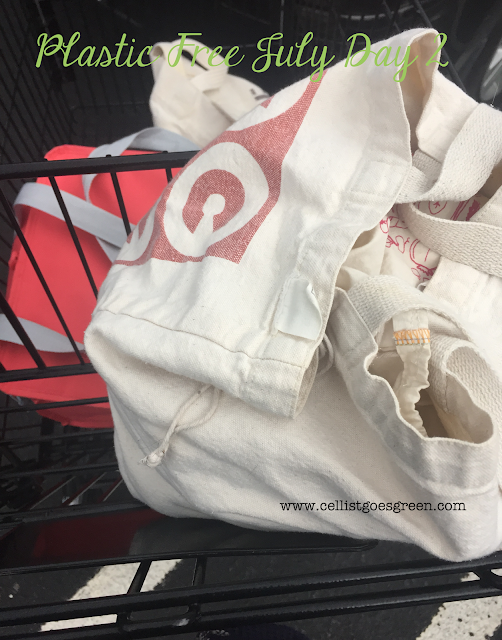
Plastic Free July Day 2 bulk shopping


I do most of my shopping at our local-ish Whole Foods (it's about 25 minutes away), because they have the best selection locally of humanely-raised meat, milk in returnable glass bottles and dry bulk goods.

How I do my shopping:
  • I bring my own canvas grocery bags
  • I use small cloth draw-string bags for bulk dry goods (dried beans, oats, lentils, etc.)
  • I bring a glass Pyrex container to the butcher, deli and cheese counter
  • I buy milk in returnable glass bottles, and bring them back to the store when they are empty

How to make bulk shopping easy for you, and the people who work at the store
  • Know the tare weight of your containers (For example, my cloth bulk bags weight .06 lbs, so when I go to the cashier, I make sure to tell them that).
  • Keep a list of PLU numbers of dry bulk items on your phone, so you can tell the cashier when you check out.  They will thank you.
  • When you go to the meat and cheese counter to fill your container, be confident.   If you sound unsure, the person behind the counter will be unsure, too.  If you feel funny asking at first, try this: "Hi!  I'd like ____ pounds of ________ in my container please!  I'm participating in Plastic Free July, which is a challenge to use less disposable plastic.  Thank you so much!"

(There is also a small health foods store near the Whole Foods which carries bulk spices and tea which we also go too.  In the summer, I try to buy the bulk of our produce from our farmers market, but they don't have much in the way of organic or low-pesticide fruit, so it's a balancing act.  Everybody's local situation is different, in terms of what is available.  Do the best you can! :)

Now, what if you don't have a store that carries bulk near you?  The Whole Foods we go to now is new, and we used to have to travel 40 minutes away--we just bought more at a time, and made fewer trips.  But I fully recognize that is not an option for everyone.

Here are some suggestions you can put in place even if your local store doesn't have any bulk:
  • Bring your own bags (Canvas bags made out of a natural material are a better choice than the plastic ones sold at the check-out lanes.  If you don't have any, I like the ones Eco Bags makes.)
  • Don't put your fruits and veggies in the plastic bags the store provides.  I promise they will be fine in your cart without a bag.  
  • Try to make whole foods (vegetables and fruits) the center of your meals.  They will obviously have less packaging than the processed food in the middle of the store.
  • You can still ask the deli to put food in your container at a conventional store. 
  •  When buying grains and beans that you use regularly, buy the biggest bag or container you think you can reasonably use before it goes bad to reduce packaging.  When you go home, empty into a glass jar or container, and it will keep longer.
If you want to know more about shopping in bulk, read my post about it here.


-------------------------------------
If you aren't familiar with Plastic Free July, take a look at this post.  Basically, it's a month-long challenge to reduce the amount of disposable plastic you use.  It's a great starting point if you just want to give cutting out disposable plastic a try.
 

My first Plastic Free July was in 2013(!), and this month I'd like to highlight some of the things I do to reduce my plastic use, and some struggles.  Many things are part of my routine at this point (buying in bulk, refusing plastic silverware, etc.), but I am not perfect, and I always find this challenge to be a good time to refocus and look at what trash I am actually producing.

Friday, July 1, 2016

Happy Plastic Free July! (Day 1)

If you aren't familiar with Plastic Free July, take a look at my last post.  Basically, it's a month-long challenge to reduce the amount of disposable plastic you use.  It's a great starting point if you just want to give cutting out disposable plastic a try.

My first Plastic Free July was in 2013(!), and this month I'd like to highlight some of the things I do to reduce my plastic use, and some struggles.  Many things are part of my routine at this point (buying in bulk, refusing plastic silverware, etc.), but I am not perfect, and I always find this challenge to be a good time to refocus and look at what trash I am actually producing.

So, today, I will share my plastic-free breakfast:

Plastic Free July Day 1 breakfast

Coffee: Beans bought in bulk and ground at home, Chemex and reusable filter
Oatmeal: Oats bought in bulk, milk in returnable glass bottle, homemade strawberry freezer jam

Monday, May 23, 2016

Preserving summer food to reduce packaging in the winter

My recycling bin changes with the seasons.  In the late fall and winter, it is fuller than I would like.  And that has to do with the lack of local produce in the colder months.  I live in an area with four distinct seasons, and our farmer's market is only open from the end of May through early November.

Preserving summer food to reduce waste in the winter


Some things I end up buying at the store off-season which are not zero-waste:
  • Salsa
  • Tomato Sauce
  • Jam

To prevent some of this waste, I would like to take advantage of my farmer's market this summer and preserve some of the wonderful locally grown, organic veggies I can get there.  Even if I can't preserve enough food to get me through the winter :), I can at least reduce how much I rely on some of these grocery store items.

On my list:
  • Fermented salsa (recipe from Zero Waste Chef) (I tried this already with some out-of-season tomatoes, and it was delicious! I can't wait to use the local tomatoes.  This isn't canned, but can keep for several months in the fridge.)
  • Tomato sauce
  • Strawberry Jam (The canned recipes use a lot of sugar, so I think I am going to stick with freezer jam)
  • Fermented pickles
 What are some things you like to preserve? Any tips for someone new to canning?

Monday, November 10, 2014

Real food staples

Last post, we talked about why preparing your own food is important.  Today, I want to share with you some of the things that have become staples in our kitchen and improved our cooking (and eating :) 


1. Chicken Stock
We usually roast a chicken once a week, and then use the leftover bones to make chicken stock.  While the stock will have to cook for several hours, the amount of hands on time is about two minutes.
  • Throw chicken carcass into your stock pot.
  • Put one to two onions (don't bother peeling, just wash, halve and cut off the ends), carrots (washed, unpeeled) and celery stalks in.
  • Add a bay leaf and a few pepper corns.  And a dash of apple cider vinegar. 
  • Cover with water and simmer for three to four hours (or more if you like).
This is super, super easy and adds tons of flavor to homemade soups and sauces.  If you are a vegetarian, you can make homemade veggie stock.

2. Homemade Applesauce
I like to put applesauce in my oatmeal every morning during the cold months.  This stuff is so much better than the canned variety.
  • Slice/core your apples.  You don't need to peel them.  I usually use about nine apples at a time.
  • Throw them in a pot.
  • Sprinkle in some cinnamon, nutmeg and a couple of cloves.
  • Simmer until the apples are a little mushy, and then throw in a blender or food processor.

3. Whole Wheat Bread
See recipe here.   Whole wheat flour, honey, molasses, salt, water and yeast.  That's it.  Good for sandwiches and spreading jam on.  Once you taste homemade bread, you will never go back.  For those weeks where we are very short on time, we do get bread from the bakery, which is still a much better choice than the prepackaged, preservative-filled breads on the store shelves.

4. Yogurt
Homemade yogurt is very easy to make.  Heat up some milk, add a little bit of pre-made yogurt, let sit overnight.  See recipe here.  Not only is this great with fruit in the morning, it also can be good as a dip (add a little lemon and dill!) and a nice addition to salads.

5. Salad Dressing
Most likely, you have everything you need to make a nice salad dressing already in your pantry. I use the recipe here, except instead of white wine vinegar, I use balsamic.  I recently used this on a kale, beet and barley salad, which was AWESOME.

This week, I challenge you to pick one thing you usually buy prepackaged, and try your hand at making it yourself.  It doesn't have to be complicated (it could even be just soaking and cooking your own dried beans!).

Let me know what you are going to make this week in the comments!


Sunday, October 26, 2014

Why cook real food?

Making your own food from scratch is probably one of the best things you can do to "go green," reduce packaging and be healthier.  (If you are not familiar with the issues of packaged food, I would strongly suggest reading "Salt, Sugar, Fat" by Michael Moss.  It was an eye opening read). While the other things I have discussed on the blog are important, in my opinion, food tops the list.  What we eat fuels our body and keeps us healthy.

At least in the United States, it seems as if we have been trapped in a mindset where convenience always wins.  Adults are over-scheduled, children are over-scheduled, and suddenly what we eat moves from the back burner to the microwave, and we become completely distanced from where our food comes from and how to prepare it.

Why real food matters | Cellist Goes Green


1. By making your own food from whole ingredients (fruits, vegetables, whole grains, meat, eggs, dairy, etc.), you avoid additives like food dye, preservatives, anti-caking agents, and artificial sweeteners and flavorings in packaged and processed food.

2. When you make your own food, you control the amount of salt, sugar and fat that goes in to it (and what kinds).  Processed foods often make up for lack of flavor by increasing these ingredients to unhealthy levels.  And while your body will still process all sugar as sugar (so it should be enjoyed in moderation!), I would rather eat raw honey than processed corn syrup. 

3. Real food tastes better.  If nothing else convinces you, this should.  Real food tastes like food.  Compare something you would normally buy packaged at the store to a time when you had that food homemade.  Did they taste the same?  Probably not.  Canned or boxed chicken stock just can't compare to the kind you make on your stove with real chicken and vegetables.  Homemade roasted tomato sauce with extra virgin olive oil is not the same as what you buy in the jar.  And that bread wrapped in plastic on the shelf is miles behind homemade or what you can get at the bakery.

4. It does not take that much time.  One of the biggest excuses for not preparing home cooked food is lack of time (I often used this one myself as a college student--I am not pointing fingers!).  Yes, it will take more time than throwing a box in the microwave, but not that much more.  And that added time is not always "active time." While chicken stock technically takes several hours to cook, those hours are not spent slaving over the stove.  Just throw everything in the pot and walk away.

5. Cooking brings us together.  Passing down recipes, techniques and sharing them with friends and family.  Taking pride in something you made and sharing it with others. All things that are invaluable and shouldn't be underestimated.


So, if you're up for a challenge: this week, pick one thing you would normally buy in a box or can and try making it yourself.  It does not have to be a big thing, it could be as simple as pumpkin puree (yum!) or soaking your own beans.

Wednesday, July 30, 2014

Wine in a plastic cup, a new Facebook page, and sending my broken charger back to Apple

Follow my blog with Bloglovin

So, a new piece of plastic has migrated into my plastic tally this month--a plastic wine cup.  Sadly, I do not have a picture, but nonetheless, it's part of the tally.  We were in an outside deck portion of a restaurant with my husband's family, and I saw they were serving drinks in plastic cups, but there were a few people with wine in real glasses, so I naively assumed that would be a safe choice.  Unfortunately not.  I asked for a real glass as soon as it was served (not too keen on enjoying wine in a plastic cup, waste aside), but the cup still went to the landfill.  I always find these things so hard to navigate, as I try to not always be the crazy plastic lady and annoy the poor waiters and waitresses, but often times when I don't say anything, I end up with unwanted plastic.

In other news, I will definitely be sending back my broken power cord to Apple, at the suggestion of Lindsay from Treading my Own Path.  If you have a broken power cord or charger from Apple, I encourage you to do the same.  We shouldn't have to accept (expensive!) products that break down so quickly, or the waste they produce.
My broken power cord, if you missed it :(
I will update you when it gets sent out.  Here is their address, if you are planning to send back your own broken charger:

Apple
1 Infinite Loop
Cupertino, CA 95014
408.996.1010

Just started a Facebook page for the blog, like us over there if you're on Facebook :)

Wednesday, July 2, 2014

Plastic Free July: Days #1 and #2

Yesterday was a successful day.  We went to a friend's house for (a delicious) dinner, and were asked to provide some dessert.  My lovely husband bought these from a local bakery:


No plastic!  Hooray!  And they were excellent.

But today, I ended up with a bottle cap from a glass bottle of vinegar (for cleaning).  Boo.  Our Whole Foods used to have bulk olive oil and vinegar, but no more.  I wouldn't have been able to afford that vinegar for cleaning anyway.  So plastic caps it is.


Plastic Tally: 1

Also on the agenda today is some homemade hummus from scratch.  I will let you know how it goes.


Saturday, June 14, 2014

Zero Plastic Week: Day 5

Sorry this post was a little late getting up.  Last night I went to go see my husband play with his jazz trio (he's a bassist) at a nice restaurant.  I was happy to see that they had their olives and peanuts in a ceramic dish, rather that those disposable cups.  Hooray for plastic-free snacking!


I've accumulated two more milk caps and rings, but that's about it so far.  We are going out to eat with my husband's parents and my brother-in-law and his girlfriend tonight.  I've been to the restaurant before, and it doesn't use any plastic ware (utensils, straws, or otherwise), so I should be safe.

If you are going to a restaurant, and you're not sure if they use disposable plastic items, here are some things that you can bring with you to help you avoid creating a ton of waste:

1. Reusable utensils.  You can bring some metal utensils from home, or you can keep some bamboo ones in your car or bag so you're always prepared.

2. Water bottle. If you're going somewhere that just sells plastic bottled water, you can bring your own bottle and ask them to fill it.

3. Glass or stainless straw. Please always tell your servers when they take your drink order that you DO NOT want a straw. And if you like drinking out of a straw, bring your own reusable one.

4. Travel mug. If you're going to a coffee place, and want your drink to-go (or they only serve in disposable cups), bring your own stainless travel mug. Even paper cups are coated with plastic (which means they won't break down for a looonng time).

Wednesday, June 11, 2014

Zero Plastic Week: Day 3

Last night I enjoyed some mint tea picked straight from the garden.  No tea bags for me!

Homemade mint tea!
And this morning, I made some coffee in our Chemex.  It was delicious.  If you haven't heard of them, the Chemex coffee maker is great!  We had a french press, which our cat broke, and we were gifted this by a friend.  We've been very happy with it.  (We use reusable filters, which you can find here).  
 

Unfortunately, I created my largest piece of plastic trash today:

Plastic from Day #3 of Zero Plastic Week
I subscribe to Taproot magazine, which I enjoy, but it unfortunately comes wrapped in a plastic bag.  The company actually addresses the issue in a post, but I'm not sure how I feel about it.  I only subscribe to two magazines, Taproot and Martha Stewart.  And I'm not a fan of e-readers.  And I enjoy reading the magazines.  Our library does not carry Taproot.  So, another conundrum.

Jar of shame :)


Here is all of the plastic I have accumulated over three days.  I know it's not a lot (6 pieces so far), but it still feels like a lot, especially since I am going out of my way to really avoid it.  

Anyway, after I finish posting this, I will be heading out to the farmers market to enjoy some plastic free produce :-)

What plastic has everybody else been struggling with this week?  Any awesome plastic-free solutions?


Monday, June 9, 2014

Zero Plastic Week: Day 1

If you have been reading recently, then you know that this week is Zero Plastic Week.  The goal is to not use any new single-use plastic for the whole week (i.e. plastic wrap, shopping bags, coffee cups, etc.)  Since the challenge is only a week, they say that you can use plastic you already have (i.e. bottles of shampoo).  (Plastic Free July will certainly help you take care of those things :)

So I started out my morning with oatmeal and tea, both of which were bought in bulk with my own containers last week.  I'm always pretty good with grains and oats, but I have been a little lazy with the tea, as I have to make another stop because the Whole Foods near us does not carry it.  Which is not an excuse, so I made sure to pick some up.

We are very lucky to have returnable, glass-bottled milk (that is bottled on the farm!) available to us.  However, they do use plastic caps, which is how I ended up with this piece of plastic this morning:


Any thoughts on how to recycle the caps?  Our municipal recycling does not take them...

I will be updating everyday this week with our plastic-free solutions and any more plastic trash we manage to accumulate.  And that's what this is really about-garbage.  Garbage that is ending up in our oceans and polluting our natural resources.  There are uses for plastic (like the keyboard I'm typing on, for instance), but we need to re-think how we are using the material as a disposable commodity.  Here is a great piece from the BBC on plastic pollution in our oceans.

Also, if you haven't seen it yet, I am giving away four bulk bags from The High Fiber so you can shop plastic free, too!  The giveaway is over on Wednesday, so enter now! :)

Monday, May 19, 2014

Getting ready for Zero Plastic Week: How do I shop for food???

Zero Plastic Week is fast approaching (June 9!), and one of the biggest changes I faced when removing plastic from my life was shopping for food.  So much of what is found in a conventional supermarket is packaged with plastic. So what can you eat??


The first thing you need to do is a find a store near your area that sells food in bulk bins. (Bea Johnson, from Zero Waste Home has a great app that will help you find bulk stores in your area) Whole Foods usually has a good selection, but often times small, local stores will also sell bulk foods.

After you find a store, you will need to put together supplies for your shopping trip.  Some suggestions, depending on what your local store sells and what you like to eat:
  • Grocery bags
  • Cloth bulk bags (These are the ones I have, but there are a ton on Etsy if you just search "bulk bags." Ecobags also has some)
  • Pint sized mason jar for freshly ground peanut butter (or almond/nut butter)
  • Bottle for bulk olive oil/vinegar (sadly they got rid of this at our store, but you may have it in yours)
  • Pyrex containers for cheese and meat
  • Paper and pencil or note application on phone to write down tare numbers and PLU's for food
Once you get to the store, the first thing you should do is go to customer service or the checkout and have them give you the weight for each of your containers and bulk bags so you are not charged extra.  Write this down so you don't have to do it each time you go to the store.

Fill your bulk bags up.  If you are going to the meat or cheese counter, make sure you are confident and straightforward with your request.  Ask for no additional paper if you can, because most of the time it is coated in plastic.

My list of bulk food PLU's on my phone
When you get to the check out, make sure you have your list of PLU numbers and tare weights handy so you are not holding up the line.  I think it's important to show that being plastic free doesn't have to be a hassle to you OR other people around you.  And that means being prepared.  I also try to group all of the things in bulk bags together on the belt so the cashier can do them all at once.

One other plastic free (or less-plastic) thing you may be able to find is milk.  Our Whole Foods sells milk in returnable glass bottles (the lids are plastic, but that's a lot less than a whole plastic gallon).  I bring a cooler with me for the bottles, and as we use them up during the week, I put the empties back in the cooler to go back to the store for next time.

At home, you can empty your bags into glass jars or containers.  Reuse empty jars that food came in, or use mason jars (the le parfait ones work well and are sturdy, if you find them on sale!).

Also, please don't forget about your local farmers market for plastic free produce.  The quality is usually better, there aren't any pesky produce stickers, and you'll get to know your local farmers.

Sign up for Zero Plastic Week here.

Friday, August 23, 2013

the beginning

Eco-conscious living has not always been a priority for me.  

As a college student, I was focused on my cello and my classes, and didn't give much thought to the effect my everyday lifestyle was having on myself or the planet.  Convenience at any cost.  Was it fast?  Was it easy?  Then who cared how much waste it produced!

Then I graduated.  And got a job (and a cat!).  And got married.  The dorm room changed to a (small) house--a house that my husband had bought before we had even been dating.  As we both worked to find ways re-organize and re-purpose the house to make it work for the both of us (i.e.: de-batchelorify it), I scoured the internet for organizing and space-saving help.  On my quest, I found several blogs that talked about using less-toxic household cleaners.

I had never really paid much attention to what was in the things that I used to clean our house.  But it made sense.  Why did I have to hold my breath, keep the window open and the fan on just to clean the shower?  Initially, I went out and bought the "green" cleaners that were sold in the grocery store, but eventually moved to using just vinegar, water, baking soda and castile soap.

After I had taken that step, it kind of snowballed.  We stopped eating the overly-processed food we had been relying on for "convenience" and started shopping the perimeter of the grocery store and the farmers market.  (Michael Moss' book, Salt, Sugar, Fat was a huge wake-up call for me, I would highly recommend it!)

The last piece of the puzzle for me was plastic.  I stumbled onto Beth Terry's blog My Plastic Free Life, and was amazed at the devastating impact our dependence on disposable plastic has on the oceans.  In the back of my mind, I was always somewhat aware of the fact we were overburdening our landfills, but I really had no idea what we were doing to the oceans and their ecosystems.  (Turtles, birds, and other marine life end up eating our discarded plastic that washes into our waterways.  Google Pacific garbage patch).  So I committed to Plastic Free July, and found I was able to GREATLY reduce our plastic consumption.  We weren't perfect--I wasn't able to find a good dish soap alternative, among a few other things--but we found a new way of functioning, which somehow felt so much more satisfying than how we had been doing it before.

I feel like I have learned so much over the beginning of our journey, and I would love to share it with anyone who wants to know more.  And I have so much more to learn from you!  We have taken small steps, and made mistakes along the way.  But that's ok.  And you don't have to be a crunchy hippie to be concerned about these issues.  I'm not.  And my (very patient) husband definitely isn't.

Why we went green

 So, why did I decide to make these choices?

1. Healthier for us: the highly processed foods we were eating and unnecessarily strong chemicals we were cleaning with were not good for us.

2. Healthier for the planet: the disposable lifestyle that I had mindlessly participated in for years is not sustainable for our climate, our wildlife, or the planet.  I started thinking about what our future children would inherit.

3. Healthier for our wallet: not spending $$$ on a cleaner for every different surface in the house, a thousand different personal care products, and every new "convenient" packaged food has saved us money, even as we invested in purchasing more organic food and higher quality things.

4. Simplicity: less disposable items means less trash and less clutter.  It feels liberating to not have my bathroom counter cluttered with a plethora of different products.  It's easier to keep everything clean when I don't come back from the store with a bunch of plastic bags and throw away packaging.

I can't wait to share more of the things I have learned, and some more of the steps we have begun to take.  Thank you so much for listening!  What steps have you taken towards a greener lifestyle?  What have you struggled with?  I'd love to hear!